POTS Relief for New Albany
A Modern, Data-Driven Approach to Healing—Without the Cracking.
POTS & Dysautonomia Relief in New Albany, IN
Living with POTS is exhausting. The racing heart every time you stand up. The dizziness, the brain fog, the fatigue that medication barely touches. If you've been diagnosed with Postural Orthostatic Tachycardia Syndrome — or suspect you might have it — We offer a drug-free approach that addresses the neurological root of your symptoms.
In patients with POTS, the body fails to properly manage blood flow and heart rate when moving from lying down to standing. The result is a cascade of symptoms that can make daily life feel impossible:
-
Heart rate spikes of 30+ BPM upon standing
-
Chronic dizziness and lightheadedness
-
Fainting or near-fainting episodes
-
Debilitating fatigue and low stamina
-
Brain fog and memory difficulty
-
Headaches and neck pain
-
Nausea and digestive problems
-
Shortness of breath and chest discomfort
-
Blurred vision
POTS affects an estimated 1–3 million Americans and is significantly underdiagnosed. Many patients spend years seeing cardiologists, neurologists, and other specialists before receiving a clear diagnosis — and even then, are often told to simply manage symptoms rather than address the cause.
How We Approach POTS at Precision Health Chiropractic
-
At our New Albany office, we focus on one of the most overlooked contributors to POTS and dysautonomia: dysfunction in the upper cervical spine.
-
The top two vertebrae in your neck — the atlas (C1) and axis (C2) — surround the brainstem, which serves as the master control center for your autonomic nervous system. When these vertebrae are even slightly misaligned, they can compress or irritate the brainstem and disrupt the very signals that regulate heart rate, blood pressure, and circulation.
-
For many POTS patients — especially those whose symptoms began after a head injury, whiplash, or neck trauma — restoring proper alignment in this region can produce meaningful improvements in autonomic function.
Our Process
Step 1 — Comprehensive Evaluation Dr. Cooke begins with a thorough health history and neurological assessment. We review your symptoms, history of injury, and any prior diagnostic workup to understand the full picture.
Step 2 — Advanced Imaging & Neurological Scanning We use precise imaging to identify specific misalignments in your upper cervical spine. Our neurological scans measure how your autonomic nervous system is currently functioning — giving us a baseline to work from.
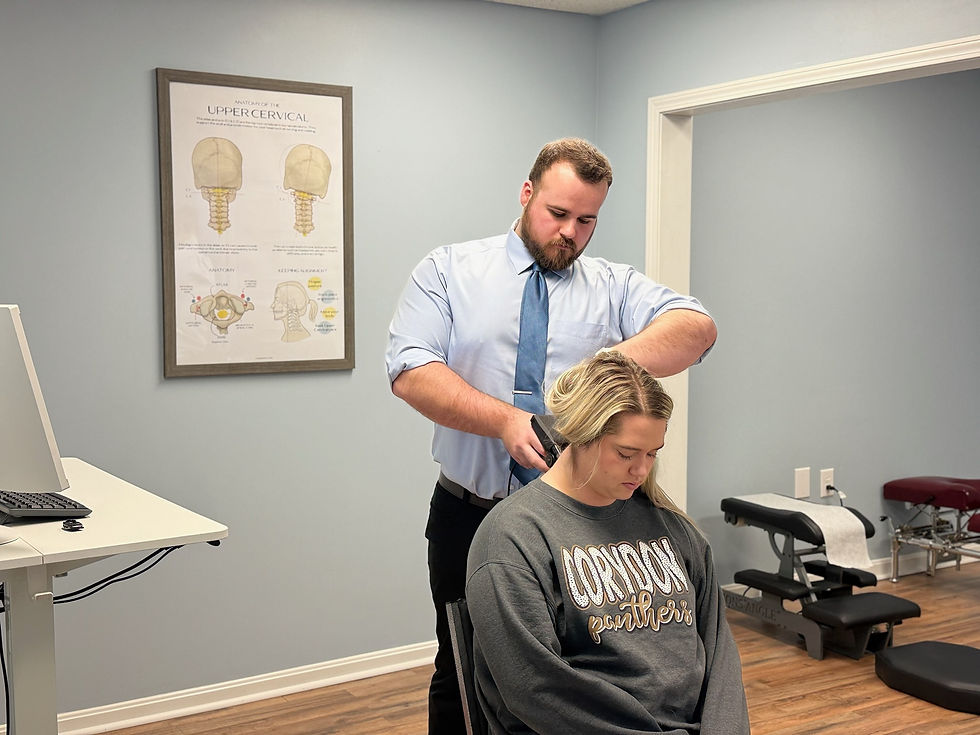
Step 3 — Gentle Upper Cervical Adjustments Our adjustments are low-force and highly targeted — no twisting, no cracking, no forceful manipulation. Because we're working in close proximity to the brainstem, precision and gentleness are non-negotiable. Most patients are surprised by how gentle the correction actually is.
Step 4 — Before-and-After Nervous System Monitoring We scan your nervous system before and after every adjustment. This means you can see objective changes in your neurological function visit by visit — not just rely on how you feel.
Step 5 — Ongoing Care & Progress Tracking POTS doesn't resolve overnight. We monitor your response over time, adjust your care plan as needed, and work alongside your other healthcare providers when appropriate.
The Advanced HIO Knee Chest Upper Cervical Technique for Vertigo Relief
What Results Can POTS Patients Expect?
Every patient is different, and we never promise specific outcomes. What we consistently see in patients who respond well to upper cervical care:
-
Fewer and less severe episodes of dizziness upon standing
-
Reduced heart rate variability and improved cardiovascular stability
-
More energy and improved daily function
-
Clearer thinking and less brain fog
-
Fewer headaches and reduced neck tension
-
Better sleep and improved overall quality of life
Chiropractic care works best as part of a comprehensive POTS management plan. We encourage patients to continue working with their cardiologist or neurologist and to incorporate other evidence-based strategies — hydration, increased sodium intake, compression garments, and gradual exercise reconditioning — alongside their care at our office.
Why Choose Precision Health Chiropractic in New Albany?
Focused Upper Cervical Focus We don't do general adjustments. Our entire practice is built around upper cervical care — the most neurologically significant region of the spine and the area most directly connected to autonomic dysfunction.
Data-Driven Care Every visit includes neurological scanning before and after your adjustment. You'll never wonder if something is changing — you'll see it in the data.
Gentle, Non-Invasive Technique No forceful manipulation. No twisting or cracking. Our low-force approach is appropriate even for patients with cardiovascular sensitivities.
Personalized Treatment Plans No two POTS patients are alike. Dr. Cooke builds a care plan around your specific misalignment pattern, symptom history, and neurological findings — not a one-size-fits-all protocol.
Precision Health Chiropractic is located at 3018 Charlestown Crossing in New Albany, Indiana. We serve patients from throughout Floyd County and the surrounding region. If you or someone you love is living with POTS and looking for a provider who takes a neurological, root-cause approach, we'd like to help.
_edited.jpg)
Contact Us